
Building a Wellbeing Routine That Actually Sticks
If you’ve ever filled a notebook with “new routine” plans and then dropped them by Wednesday, you’re in the right place.
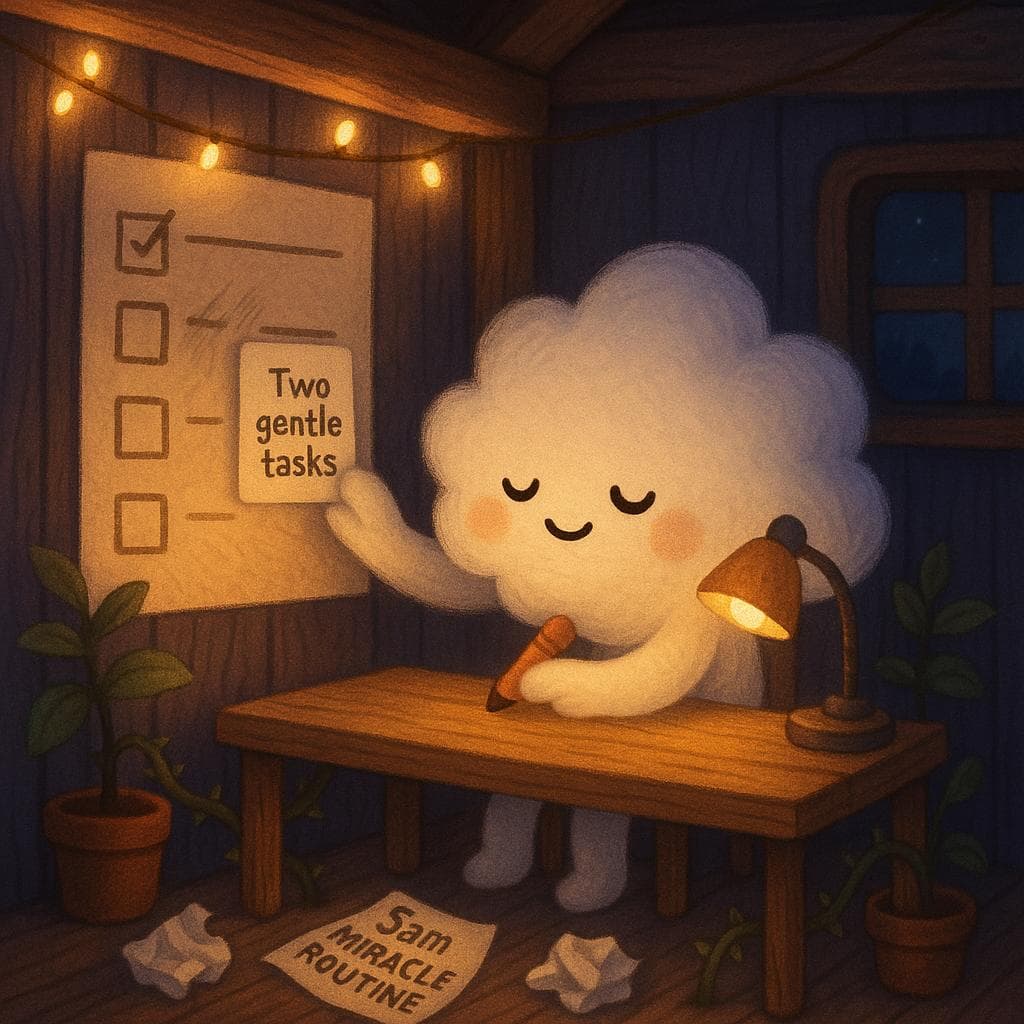
Especially if you’re juggling ADHD, anxiety, classes, work, and just… existing, the usual “5am miracle routine” advice feels like a joke. You might swing between “I’m going to change my whole life this week” and “I can’t even wash this one mug, what’s wrong with me?”
Nothing’s wrong with you. A lot is wrong with the routines you’ve been sold.
This guide is about building a wellbeing routine that actually sticks—slow, flexible, and kind, like tending a small garden instead of trying to build a whole jungle gym overnight.
Key Takeaways:
✓ Routines fail less because you “lack discipline” and more because they’re too big, too vague, or not designed for ADHD/anxious brains
✓ Tiny, 1–3 minute actions tied to things you already do (like brushing teeth or opening your laptop) are way more sustainable than full lifestyle overhauls
✓ A good wellbeing routine has 3 parts: grounding (body), noticing (mind), and connecting (people or meaning)—you can start with just one
✓ Tracking small wins with a gentle wellness tracker or mood journal helps your brain actually notice progress, which boosts motivation over time
✓ This isn’t a replacement for therapy or counseling, but it’s a realistic way to support your emotional health—especially if you can’t afford therapy right now
1. Why routines feel so hard
If you’ve tried to build a routine before and “failed,” your brain might tell you a story: you’re lazy, inconsistent, or bad at adulting.
That story is wrong—and honestly, kind of rude.
Your brain isn’t the enemy
For young adults, emotional struggles are extremely common. In recent national data, about one in three young adults 18–25 had some kind of emotional or behavioural condition in the past year, and only about half received any support for it (SAMHSA, 2024). If you feel like keeping up with routines is harder for you than for other people, there’s a good chance you’re dealing with extra invisible weight—like anxiety, low mood, ADHD, or all three.
ADHD and anxiety in particular can make routines tricky because:
- ADHD makes time feel slippery, planning exhausting, and boring tasks painful
- Anxiety makes you overthink every step and fear doing it “wrong”
- Low mood drains your energy and makes everything feel pointless
So when you try to start a huge new routine, your brain is already overwhelmed before you even begin.
The usual routine advice is not built for you
Common advice:
- “Just wake up earlier and workout for an hour.”
- “No phone for the first 2 hours of the day.”
- “Stick to the same schedule every single day.”
For a lot of college students and young adults, that’s just not real life. You might:
- Have rotating class schedules or shifts
- Share a dorm or apartment with loud roommates
- Be managing chronic stress, low mood, or family responsibilities
- Be up late finishing assignments or doomscrolling because your brain won’t switch off
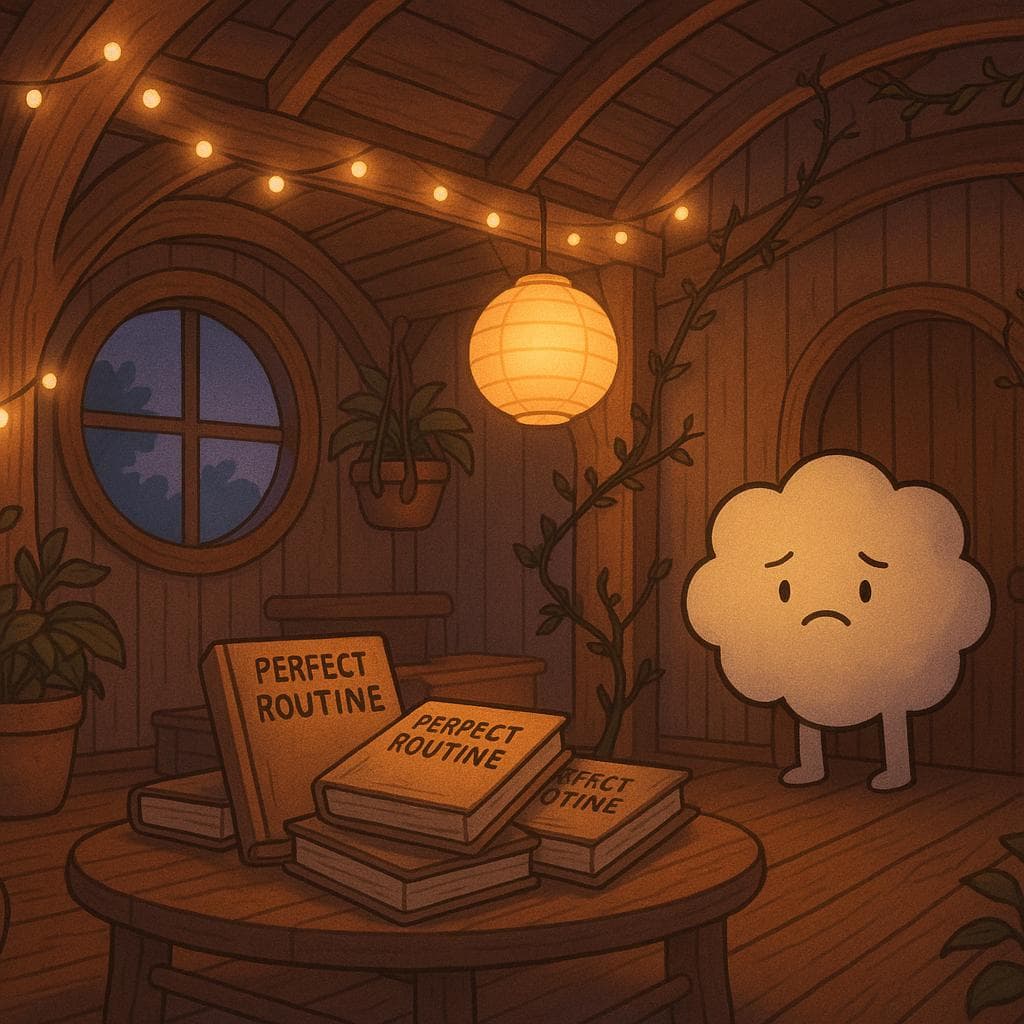
So of course the “perfect routine” collapses by day three. It was never designed for your reality.
In summary: You’re not failing routines. The routines you’ve tried are failing you.
2. What a “sticky” wellbeing routine actually is
Let’s redefine this.
A wellbeing routine that sticks is:
- Small – can be done even on bad days
- Flexible – can shift with your schedule and energy
- Visible – you can see that you did it (not just “feel” it)
- Supportive – helps your brain and body calm down, not rev up
Think of your routine like a garden path, not a prison schedule. You’re laying down a few stepping stones you can walk most days, not building a highway you must drive perfectly.
The three pillars: body, mind, connection
You don’t need 20 habits. You just need a couple of tiny ones in each of these areas.
| Pillar | Goal | Tiny habit examples |
|---|---|---|
| Body | Calm your nervous system | 3 deep breaths, 1-minute stretch, sip water |
| Mind | Notice and name your state | 1-line mood check, quick journal prompt |
| Connection | Feel less alone/adrift | 10-word text, 30-sec gratitude, send a meme |
You can start with one pillar and add the others later.
Example:
“Right now I’m in survival mode with finals. For the next two weeks, my only routine goal is: after I brush my teeth at night, I’ll write one sentence about my day in my notes app.”
That still counts as a wellbeing routine. Seriously.
3. Designing routines for ADHD and anxiety
If your brain is fast, scattered, or anxious, you need routines that work with it, not against it.
Make it embarrassingly small
If the habit feels “too small to matter,” you’re probably closer to the right size.
Instead of:
- “I’ll journal for 20 minutes every night.”
Try:
- “I’ll write one sentence about how I feel while my laptop is shutting down.”
Instead of:
- “I’ll meditate for 15 minutes every morning.”
Try:
- “I’ll close my eyes and take 3 slow breaths before I open TikTok.”
Your brain might scream, “This won’t change anything.” That’s just perfectionism talking. Research on behaviour change shows that tiny, consistent actions are what actually rewire habits over time—especially when bigger routines keep collapsing.
Anchor habits to things you already do
ADHD brains hate floating tasks like “journal sometime today.” You need anchors.
Attach your tiny habit to something that already happens almost every day:
- After I brush my teeth, I drink a full glass of water
- When I open my laptop for class, I rate my energy 0–10
- When I get into bed, I do a 30-second body scan
- When I plug in my phone at night, I send one check-in text
The formula is: After I [existing thing], I will [tiny habit].
Plan for low-energy days on purpose
Most routines are built for “ideal you” on your best day. That person shows up maybe twice a month.
Instead, design a minimum version and a bonus version:
| Habit | Minimum version (bad day) | Bonus version (good day) |
|---|---|---|
| Movement | Stand up and stretch for 30 seconds | 10-minute walk or YouTube workout |
| Journaling | Write 1 feeling word | 10 minutes of free-writing |
| Social | React to a friend’s story with an emoji | 20-minute FaceTime or hangout |
✅ Good approach: “On bad days, I only have to do the minimum. On better days, I can do more, but I don’t have to.”
❌ Not helpful: “If I can’t do the full version, I failed and should start over Monday.”
This “minimum vs bonus” mindset is huge for anxious and ADHD brains that tend to think in all-or-nothing mode.
4. Tiny routine ideas you can start today
You do not need to do all of these. Skim and pick one or two that feel doable.
Morning (or whenever you wake up)
These help with groggy anxiety and that “I’m already behind” feeling.
-
Name your weather
When you wake up, ask: “What’s my weather today?” and answer with one word (sunny, cloudy, stormy, foggy). You can say it in your head or type it in your notes.
-
Light + water combo
Open your blinds or turn on a lamp, then drink a few sips of water. That’s it. Light and hydration are tiny signals to your brain that the day has started.
-
One kind thought
Before you grab your phone, think or whisper: “Today, I’ll try to be 5% kinder to myself.” It’s not a promise to be perfect—just a small nudge.
If you want more ideas for mornings specifically, we have a whole guide on morning routine ideas for managing anxiety that actually feel doable.
During the day
These are for between classes, at work, or while doomscrolling.
-
Two-breath reset
Whenever you switch tasks (open a new tab, close a lecture, finish a text), pause for just two slow breaths before starting the next thing.
-
Micro-move
While waiting for something to load, stand up, roll your shoulders, or walk to fill your water. Keep it under a minute so your brain doesn’t freak out about “taking a break.”
-
One-sentence check-in
Once a day, type one sentence like:
- “Right now I feel ___ because ___.”
- “My brain is at ___/10 focus, ___/10 energy.”
This can go in a notes app, a paper notebook, or a mood journal.
Evening / pre-bed
Evenings are when low mood, guilt, and anxiety about “not doing enough” tend to spike.
-
Done list, not to-do list
Instead of listing what you “should” do tomorrow, write 3 things you did today, no matter how small:
- Got out of bed
- Answered one email
- Watched a comfort show
-
Gentle shutdown
Pick a time that’s “screens mostly off” (not perfect, just less). At that time:
- Lower brightness
- Close one app
- Put your phone a tiny bit farther away (even on the other side of the bed)
-
Future-you favor
Do one 30-second thing your future self will appreciate:
- Put a snack on your desk for tomorrow
- Lay out leggings and a hoodie
- Put a glass of water by your bed
If nighttime is when your brain really spirals, you might also like our guide on when you’re feeling too low to do basic self-care.
5. Making it stick (without perfectionism)
Okay, you’ve picked a couple of tiny habits. How do you keep them going longer than three days?
Track progress in a way your brain can see
When you’re dealing with anxiety or low mood, your brain has a bias toward remembering what went wrong. It will absolutely forget that you did your tiny habits four days in a row.
That’s why some form of visible tracking helps:
- Mark a tiny dot on a calendar for each day you do your minimum
- Use a simple habit tracker or wellness app
- Keep a running list in your notes: “Today I: drank water, stretched, texted Sam”
The goal isn’t a perfect streak. It’s giving your brain visual receipts: “Look, I am tending to myself, even when it doesn’t feel like it.”
We’ve also broken down more ideas in our post on building a wellbeing routine that actually sticks if you want another angle on this.
Expect wobble days
You will miss days. That’s not a bug—it’s part of being human.
Instead of “I ruined it,” try:
- “Today was a no-plant-watering day. Tomorrow I’ll give one leaf a mist.”
- “I did nothing yesterday. My only job today is the minimum version.”
A helpful rule: Never miss twice for the same reason.
If you skipped your habit because you were exhausted, cool. Next time you’re exhausted, try doing the tiny version, even if it’s just 10 seconds.
Adjust instead of quitting
If you keep skipping a habit, it’s usually because:
- It’s too big
- It’s at the wrong time
- It’s not connected to anything you care about
Instead of blaming yourself, tweak the habit:
- Make it smaller (3 breaths instead of 10 minutes)
- Move it (after lunch instead of first thing in the morning)
- Tie it to a value (“I do this because I want to be kinder to myself,” not just “because I should”)
Example:
“I keep failing at journaling at night because by then I’m fried. I’ll switch to writing one sentence right after my first class instead, while my brain is still semi-alive.”
That’s not giving up. That’s tending your routine like a plant—moving it to a sunnier windowsill when it’s not thriving.
6. Putting it all together
Here’s how this can look in real life, without the aesthetic Pinterest energy.
Step 1: Choose your focus
Pick one pillar for the next 1–2 weeks:
- Body
- Mind
- Connection
Say you pick Mind.
Step 2: Pick one tiny habit
Example: “After I open my laptop for my first class, I’ll write one sentence about how I’m feeling.”
Minimum version: one word (“tired,” “numb,” “okay”)
Bonus version: one or two full sentences
Step 3: Decide how you’ll track it
Options:
- Checkbox in your planner
- Tiny star in your calendar
- A simple habit tracker or wellness app
- A running note titled “Tiny check-ins”
Step 4: Run a 7-day experiment
For one week:
- Do your minimum habit most days (not all—most is enough)
- Notice:
- What made it easier?
- What got in the way?
- Adjust if needed (time of day, location, size of habit)
At the end of the week, ask:
- Did this help me feel even 5% more aware/grounded/connected?
- If yes, keep it and maybe add one more tiny habit in another pillar.
- If no, change the habit—not yourself.
Over time, you’ll have a small cluster of habits—like a few plants in your window box. Not a full jungle. Just enough to remind you that you’re worth tending to, even on the messy days.
7. Gentle next step
You don’t have to overhaul your life this week. You don’t even have to “get your routine together.”
All you need to do today is:
Pick one tiny habit and one anchor.
For example: “After I plug in my phone tonight, I’ll write one sentence about how my day felt.”
That’s it. That counts.
If you’d like a soft place to keep track of these little habits and see your progress grow over time, you can download Melo and plant your tiny actions in a digital garden that reflects how you’re tending to yourself—especially on the days your brain forgets to give you credit.
Note: This article is for information and support only. It’s not a substitute for professional care. If you’re going through a tough stretch or your routines feel impossible for a long time, reaching out to a therapist, counselor, or other trusted professional can be an important extra layer of support for your emotional wellbeing.